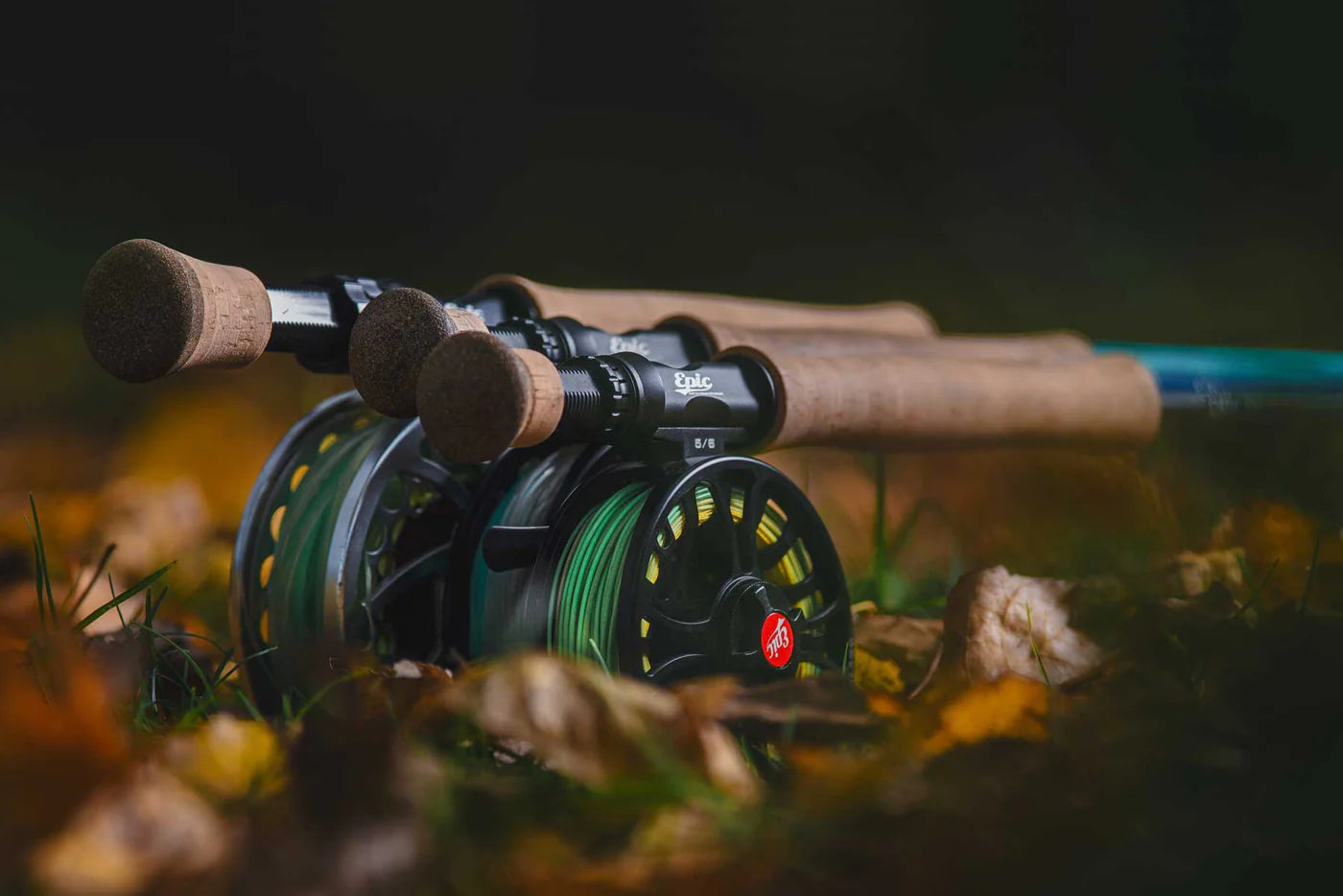
Buying a carbon grip for a fly rod – what to look for when choosing
A grip does not determine the actual action of a fly rod blank. But it does determine how directly a finished fly rod feels in your hand.
Weight, grip contour, surface, and construction influence the balance, ergonomics, and subjective feedback of the rod. Those who want to buy a carbon grip for their fly rod are usually consciously looking for low weight, direct feedback, and a modern alternative to the classic cork grip.
For the grip to not only look good later, but also feel truly harmonious on the water, the blank diameter, inner diameter, grip length, shape, and application area must match.
Why choose a carbon grip for a fly rod?
Carbon as a grip material is particularly interesting for modern and technically oriented custom fly rods.
The material is dimensionally stable, absorbs hardly any moisture, and can be processed very precisely. Unlike natural cork, carbon has no pores or filler spots that can change or break out over the years.
The biggest difference, however, lies in the feel.
A carbon grip provides a relatively direct connection to the blank and dampens less than cork or EVA. Movements and vibrations can thus be felt very directly in the hand.
Especially in Euro Nymphing and ESN, where contact with the leader, sighter, and nymphs plays a central role, this direct feedback can feel particularly pleasant.
Therefore, carbon is not simply a modern version of cork.
It has a very unique character.
Carbon or cork – two different sensations
A high-quality cork grip feels warm, natural, and slightly yielding.
Carbon, on the other system, appears clearer, more technical, and more minimalist.
Which is better depends on the character of the fly rod.
For a classic fiberglass fly rod on a small stream, flor-grade cork might be a perfect match. For a modern nymphing rod, fast carbon rod, or deliberately minimalist custom rod, a lightweight carbon grip for fly rods can be exactly the right choice.
Carbon grip for light trout and small stream rods
For short fly rods in classes #1 to #4, the grip should remain as compact and light as possible.
Slender Half Wells, Reverse Half Wells, or Cigar grips usually fit better here than voluminous Full-Wells shapes.
A particularly interesting grip is the Soulmate Carbon Ultralight SilkTouch Reverse Half Wells.
Weighing only around 14 g and with a length of 17.8 cm, it is designed for light fly rods in classes #1 to #5. The SilkTouch surface combines the lightweight carbon construction with a more pleasant, less harsh feel.
This concept is particularly interesting for light carbon blanks, dry fly rods, or modern small stream setups.
SilkTouch – Carbon doesn't have to feel cold
Not every carbon grip is smooth, hard, or high-gloss.
Surfaces like SilkTouch significantly change the grip feel.
The advantage is that the low mass of carbon is retained, while the surface feels a little softer and less technical.
For fly fishers who want the benefits of a carbon grip but prefer a more pleasant feel, this is an interesting intermediate solution.
Full Wells Carbon Grip for more powerful fly rods
As the line class increases, the grip can have a bit more volume.
For a #5 or #6 all-round fly rod, when streamer fishing, or on a faster coastal rod, a Full Wells Carbon Grip offers more surface area for the hand.
This can be particularly pleasant for double hauling and casting larger flies.
Here too, the weight advantage of carbon remains interesting: a well-constructed Full-Wells grip can remain very light despite its larger shape.
For pike, coastal, or more powerful saltwater rods, a fighting butt can also be useful.
Carbon grips for Euro Nymphing and ESN
For Euro Nymphing rods, the grip is particularly important.
A 10', 10'6" or 11' long nymphing rod develops a stronger tipping moment in front of the hand due to its length.
Therefore, the lightest grip is not automatically the best solution.
While a carbon grip reduces the overall weight, the balance of the entire fly rod should always be assessed with the reel that will be used later.
For ESN, therefore:
Not the lowest weight wins – but the best balance.
The real advantage of carbon here lies in its direct feel, precise shape, and the ability to build the grip area very slender and technical.
Measuring the inner diameter of the carbon grip correctly
When building fly rods with carbon grips, not only the length and outer shape should be considered.
At least as important is the inner diameter.
Since a blank tapers, the diameter should be measured where the front and back edges of the grip will later sit.
A single measurement at the blank tip is not enough.
If the inner diameter is too small, the carbon grip must under no circumstances be forced on.
The grip must be carefully adapted.
If it is significantly too large, the difference should be compensated with suitable arbors or a clean underlay. A large void should not simply be filled with epoxy adhesive.
Dry assembly before gluing
Before glue comes into play, the entire grip area should be dry-assembled.
This allows checking:
Does the grip length fit?
Does the hand rest naturally?
Is the transition to the blank correct?
And does the fly rod feel balanced with the reel that will be used later?
This dry test saves a lot of rework later.
Especially with carbon grips, small gaps or crooked transitions are optically more noticeable than with natural cork.
Surface and care of carbon grips
Carbon grips are generally very easy to care for.
After normal freshwater use, a damp, soft cloth is usually sufficient.
After saltwater contact, the grip should be cleaned with fresh water and then completely dried.
Aggressive solvents or strong chemical cleaners should be avoided – especially with special surfaces like SilkTouch.
Carbon, cork or EVA?
All three materials have their justification.
Cork is warm, light and classic and fits perfectly with trout, fiberglass and dry fly rods.
EVA is robust, grippy and uncomplicated – particularly interesting for harsh operating conditions.
Carbon is light, dimensionally stable, modern and direct and is particularly suitable for Euro-Nymphing, modern carbon blanks, light performance builds and technically minimalist custom fly rods.
Carbon is therefore not a substitute for cork.
It is an independent decision.
Which carbon grip fits which fly rod?
As a rough guide:
- #1–#4 Small stream and light trout rods: slender Half Wells or Reverse Half Wells
- #4–#6 All-round fly rods: Half Wells or light Full Wells
- ESN / Euro Nymphing: light, direct carbon grip – definitely check balance with reel
- #6–#8 Streamer and coast: Full Wells
- #8 and up: powerful Full Wells, possibly with a Fighting Butt
However, your own hand always remains the deciding factor.
Buying a carbon grip for a fly rod – as part of the entire build
Those who want to buy a carbon grip for their fly rod should primarily know the blank diameter, line class, application area, grip length, and grip contour.
At MB-Customrods, you'll find a selection of carbon grips for fly rods for various line classes and rod concepts – from the ultralight SilkTouch Reverse Half Wells to more powerful Full-Wells versions.
In the end, the grip is the part of the fly rod you touch the longest.
Here you feel the balance, movement, and feedback of the blank.
And that's precisely why it's worth choosing it not just by its appearance.
The right carbon grip should eventually become unnoticeable – and simply feel as if it has always belonged to this rod.
As a Meta Title, I would continue to use: “Buy Carbon Grip for Fly Rod | Rod Building Guide”.
Meta Description: “Choosing carbon grips for fly rods: advantages, shapes, balance, and assembly. Tips for SilkTouch, Full Wells & carbon grips for fly rod building.”