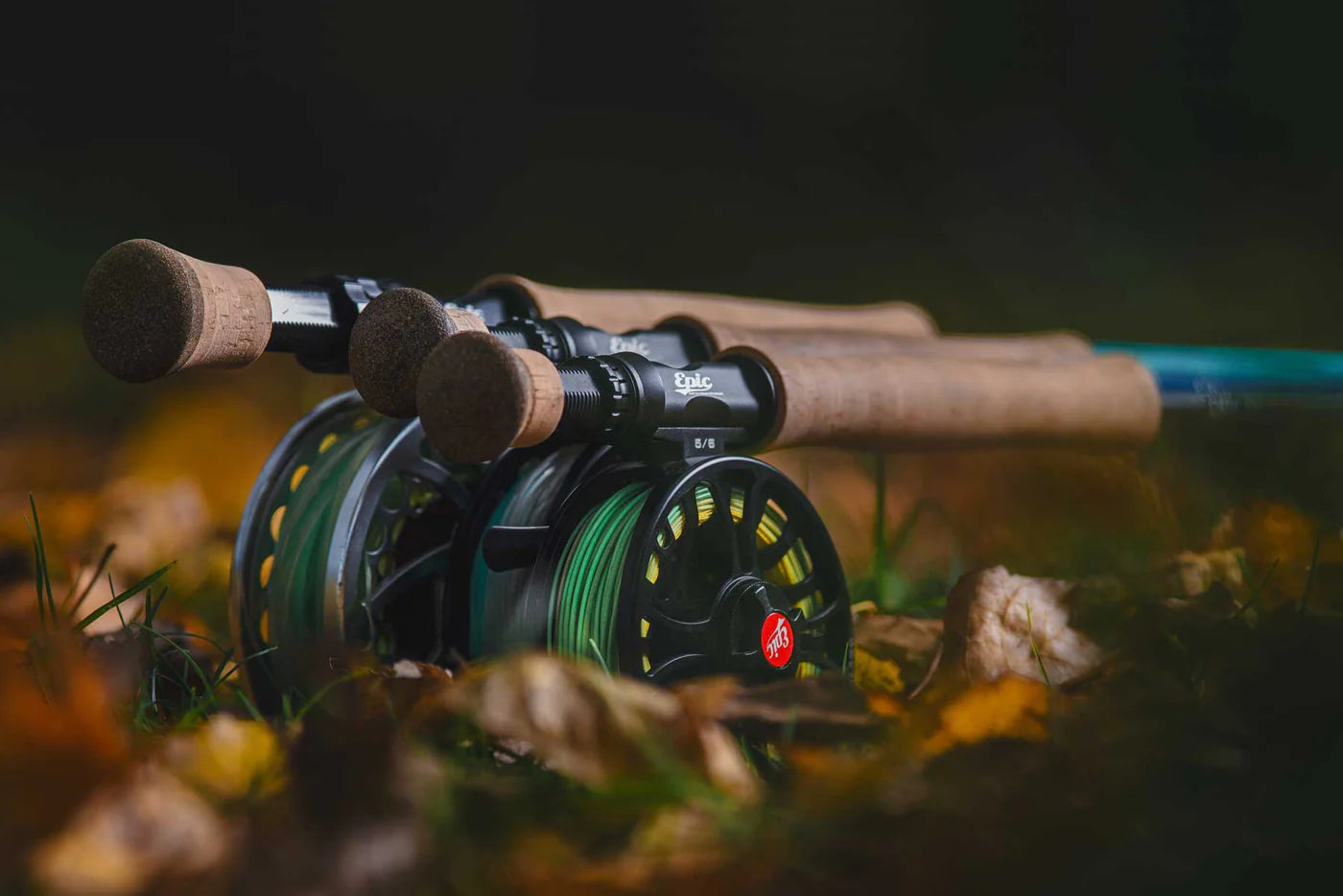
Fiberglass Fly Rods – Ideal for Small Streams!
When overhanging alder trees only allow a narrow casting window, branches hang low over the water, and the next small pool is barely ten meters away, maximum casting distance isn't the deciding factor in fly fishing.
Then something else matters:
Feel. Control. Timing.
This is precisely where a fiberglass fly rod for small streams truly excels.
Modern fiberglass rods load noticeably with very little line extended beyond the rod tip. Short roll casts, small overhead casts, or a precise bow-and-arrow cast can be executed with astonishingly little effort.
And when the dry fly finally lands exactly under the overhanging branch and a trout emerges from the shadows, fiberglass shows why these rods captivate so many fly fishermen.
Because a good fiberglass fly rod doesn't just make small waters fishable.
It makes them intense.
Why Fiberglass is So Much Fun on Small Streams
A modern fiberglass fly rod typically has a deeper and more progressively bending curve than a comparable carbon rod.
This doesn't automatically mean it's simply "slow."
More accurately:
You feel the blank working.
With just a few meters of line, the rod loads significantly. The blank provides clear feedback to the caster about when enough energy is stored to transport the line cleanly forward.
This is a major advantage, especially at short distances.
Because where a very fast carbon rod often only really starts to work with more line, a good fiberglass blank feels alive with just a few meters.
This makes short casts controlled and intuitive.
Small Casting Windows, Short Distances – Exactly the Domain of Fiberglass
On small streams, fly fishing rarely takes place in an open field.
A branch hangs in the back cast.
A bush stands to the left.
A root lies to the right.
And precisely where there's no space left, a fish rises.
That's small stream fishing.
With a short fiberglass fly rod, such situations can be managed surprisingly relaxed.
Roll casts, side casts, small switch casts, or a bow-and-arrow cast work particularly well within a few meters because the blank loads even under light tension.
This is especially true for short models like the Soulmate Pine Creek 663 S-Glass Blank with 6'6" and line class #3.
If you want to build a compact rod for tight, heavily overgrown streams, you'll find various models for exactly this application in the Soulmate Fiberglass Blank Collection at MB-Customrods.
Presentation – Often More Important Than Casting Distance
On a small, clear stream, the fly is often only a few meters away from the fly fisherman.
The fish sees a lot.
And it has little time to decide.
A controlled, gentle presentation can therefore be crucial.
The progressive bending curve of many fiberglass blanks ensures that the line unfurls smoothly. Small dry flies, CDC patterns, Klinkhåmers, beetles, or light hoppers can thus be presented very delicately.
Especially when a fly needs to land in a small open window between two branches, this feel for the working rod is enormously valuable.
You don't just cast.
You feel the cast.
And Then Comes the Bite
Perhaps this is the moment when fiberglass finally becomes addictive.
A 25-centimeter brown trout can make a light glass rod work deeply.
A larger fish will then bend the blank far into the mid-section.
The rod cushions escapes and headshakes very smoothly, thereby excellently protecting fine tippets and small hooks.
However, this does not mean that a fiberglass fly rod lacks power.
A modern S-Glass or progressive E-Glass blank can build up surprisingly much pressure.
The key is to choose the right line class for your water.
Because if the fish pulls under a root or into an undercut bank immediately after the bite, it's not just about feel.
Then the rod also needs reserves.
What Length for a Fiberglass Fly Rod on Small Streams?
For many small streams, the most interesting range is between approximately 6'6" and 7'6".
Which length is best depends heavily on how tight the water truly is.
6'6" – The Specialist for Really Tight Streams
A 6'6" rod is ideal when trees and bushes reach almost to the water.
It can be positioned quickly and requires very little space.
For small forest and low mountain range streams, such a rod is incredibly practical.
The Soulmate Pine Creek 663 S-Glass with 6'6" and line class #3 embodies precisely this concept.
Short.
Light.
Direct.
And built for situations where every meter of maneuvering room counts.
7'0" to 7'3" – The Sweet Spot for Smallstream Fishing
For many small trout streams, lengths between 7 and 7'3" are particularly versatile.
They remain short enough for tight bank vegetation but offer a bit more reach and line control than a very short 6'6" rod.
Small pools, pocket water, short drifts, or a slightly wider section of the stream can be fished excellently with them.
A very exciting example is the Soulmate Glassic 703 S-Glass Blank with 7 feet and line class #3.
If you're looking for a classic, light small stream build, you'll also find such models in the Soulmate Fiberglass selection at MB-Customrods.
7'6" – A Bit More Reach Without Losing the Glass Character
A 7'6" glass rod is excellent for streams that are not consistently extremely tight.
Perhaps a small, overgrown section is suddenly followed by a larger pool.
Or the stream regularly opens up to ten or fifteen meters wide.
Then the extra six inches are very pleasant.
The rod can control more line and offers a bit more reach for mending and longer drifts.
Models like the Soulmate Glassic 764 S-Glass combine this additional range of action with the typical, deep fiberglass feel.
Line Class #2, #3, or #4?
Especially with fiberglass fly rods, the line class is crucial for the character of the finished rod.
Class #2 – Maximally Delicate
A #2 is for fly fishermen who consciously want to go very light.
Small dry flies.
Fine leaders.
Short distances.
Small to medium-sized trout.
Such a rod makes even small fish incredibly intense.
However, it requires a bit more calm when casting and has fewer reserves for wind, large flies, or stronger currents.
Class #3 – The Smallstream Classic
For me, the #3 is one of the most exciting line classes for small streams.
It remains delicate and light but has enough reserves for a small hopper, a nymph under a dry fly, or a surprisingly strong fish.
Models like the Soulmate Glassic 703 or the Soulmate Pine Creek 663 are classic examples of this concept.
A #3 is light enough that small fish are fun.
But not so light that every larger fish becomes a problem.
Class #4 – A Bit More Punch
A #4 already brings noticeably more mass into the system.
This helps particularly with short roll casts, larger terrestrial patterns, hopper-dropper setups, or a small streamer.
If you fish a stream where stronger fish regularly appear alongside smaller trout, a #4 can be very well-suited.
The Soulmate Black Series 704 with 7 feet and class #4 is also an interesting example of a slightly more powerful small stream blank.
All currently offered models can be found under Fiberglass Fly Rod Blanks from MB-Customrods.
Fiberglass is Not All the Same
One of the biggest misconceptions is:
"Glass rods are all slow."
That's not true.
There are very deep-working full-flex blanks, progressive fiberglass blanks, and comparatively stiff S-Glass constructions with surprisingly fast recovery.
This is precisely why a close look at each blank series is worthwhile.
Full Flex
A classic full-flex blank works far down into the handle.
This creates a very deep, unhurried casting feel.
Short dry fly casts become an experience because you practically feel the entire blank loading.
Progressive Fiberglass Blanks
Progressive blanks react delicately at the tip, but build up increasing power through the mid-section and butt with increasing load.
This makes them appear somewhat more modern and versatile.
For fly fishermen who have predominantly fished fast carbon rods so far, a progressive fiberglass blank is often the easier entry point.
S-Glass or E-Glass
The type of fiberglass material used also influences the character.
Modern S-Glass allows for comparatively light, durable, and responsive blanks.
E-Glass, on the other hand, can have a very classic, deep character.
Ultimately, it's not just the material designation that matters, but how the construction, wall thickness, and taper have been combined.
The Right Fly Line Makes the Difference
A fiberglass fly rod can only perform as well as the line it's paired with.
Especially on small streams, there are often only a few meters of line outside the rod tip.
Therefore, the rod should load cleanly even at short distances.
A WF fly line with a more compact head can be very well suited for this.
The Soulmate Glassline, for example, was developed specifically with modern fiberglass fly rods in mind.
However, it applies that:
More weight isn't automatically better.
A too aggressive taper can alter the delicate presentation.
For small dry flies and calm pools, a slightly finer front section can be particularly pleasant.
For roll casts, hoppers, or short nymph rigs, the line may have a bit more mass in the front section.
Leader and Tippet on Small Streams
For many small stream situations, leaders between 7.5 and 9 feet are a good starting point.
But here too, the water dictates.
Under deeply hanging branches, a shorter leader can be significantly more controllable.
In a clear, shallow pool, on the other hand, a longer leader can help create more distance between the fly line and the fish.
The same applies to the tippet:
As fine as necessary – but no finer.
0.10 to 0.14 mm can be sensible for small dry flies.
However, if roots, undercuts, or larger trout are part of the water, a stronger tippet may be the much better decision.
Fiberglass and Nymph – Is That Possible?
Of course.
A fiberglass fly rod is by no means exclusively a dry fly rod.
A single weighted nymph, a small indicator, or a dry-dropper or hopper-dropper setup work excellently.
Especially with short drifts, the deeper action can even be very pleasant.
For consistent Euro Nymphing with long leaders, a consistently high rod tip, and maximally direct contact, a specialized nymphing rod is the better choice.
Fiberglass simply wasn't optimized for this application.
When Building a Fiberglass Fly Rod, Every Detail Counts
A beautiful fiberglass rod doesn't just come from the blank.
It comes from the entire build.
Especially with short, light rods, unnecessary weight should be avoided.
A massive reel seat, oversized guides, or overdimensioned components can significantly alter the character of a fine blank.
Grip
A slender Western, Cigar, or Half-Wells grip perfectly suits light fiberglass rods.
The grip should not only aesthetically match the blank.
Above all, it should feel good in the hand.
Especially with a short #3, you don't need the massive grip of a saltwater rod.
Reel Seat
Wood spacers fit perfectly aesthetically with the classic character of a glass rod.
Those who prefer a more modern build can use aluminum or other lightweight materials.
Balance remains important.
Guide Set
Light snake guides fit excellently with many fiberglass fly rods, both functionally and aesthetically.
Especially in the tip section, the guide set should not be unnecessarily heavy.
Because every additional gram influences the recovery behavior.
When rod building, it is therefore worthwhile to check the guide spacing under load before final wrapping.
The blank should work as harmoniously as possible and guide the line cleanly along the bending curve.
Why Build Your Own Fiberglass Fly Rod?
Perhaps hardly any other rod fits the idea of custom rod building as well as a fiberglass fly rod.
Because here, it's rarely just about maximum performance.
It's about character.
The color of the blank.
A special wood spacer.
Fine wraps.
A slender cork grip.
Perhaps a classic agate stripping guide.
And eventually, you stand by a small stream with exactly this rod.
The fly lands under a branch.
A fish rises.
The blank bends deeply.
And suddenly, you remember why you built this rod.
At MB-Customrods, you'll find a large selection of fiberglass fly rod blanks, including numerous Soulmate Fiberglass Blanks for small streams, light line classes, and classic as well as modern fiberglass builds.
When Carbon is Still the Better Choice
Fiberglass is not automatically the best solution for every small stream.
In strong winds, for long casts, or with larger and heavily weighted streamers, a modern carbon blank often offers advantages.
Carbon usually achieves higher line speed and can work more efficiently at longer distances.
Even those who prefer a very fast, direct casting style may feel more comfortable with carbon.
But if your fly fishing primarily takes place where distances are short, streams are overgrown, and fish are right at your feet, then fiberglass is worthwhile.
Not because a glass rod can do everything better.
But because it makes precisely this type of fly fishing particularly intense.
The True Domain of a Glass Rod Often Begins at Six Meters
Imagine a small stream.
A deep pool under a root.
Perhaps six meters away.
Between you and the fish hangs a single branch over the water.
You don't need 25 meters of line.
You need a clean cast.
The rod loads.
The line unrolls.
The fly lands.
A brief moment.
Then it disappears.
You lift the rod and the entire blank comes alive.
That's exactly what fiberglass fly rods were made for.
Those who want to build their own rod for such moments will find the suitable Soulmate Fiberglass Fly Rod Blanks and other Fiberglass Blanks in the MB-Customrods Shop.