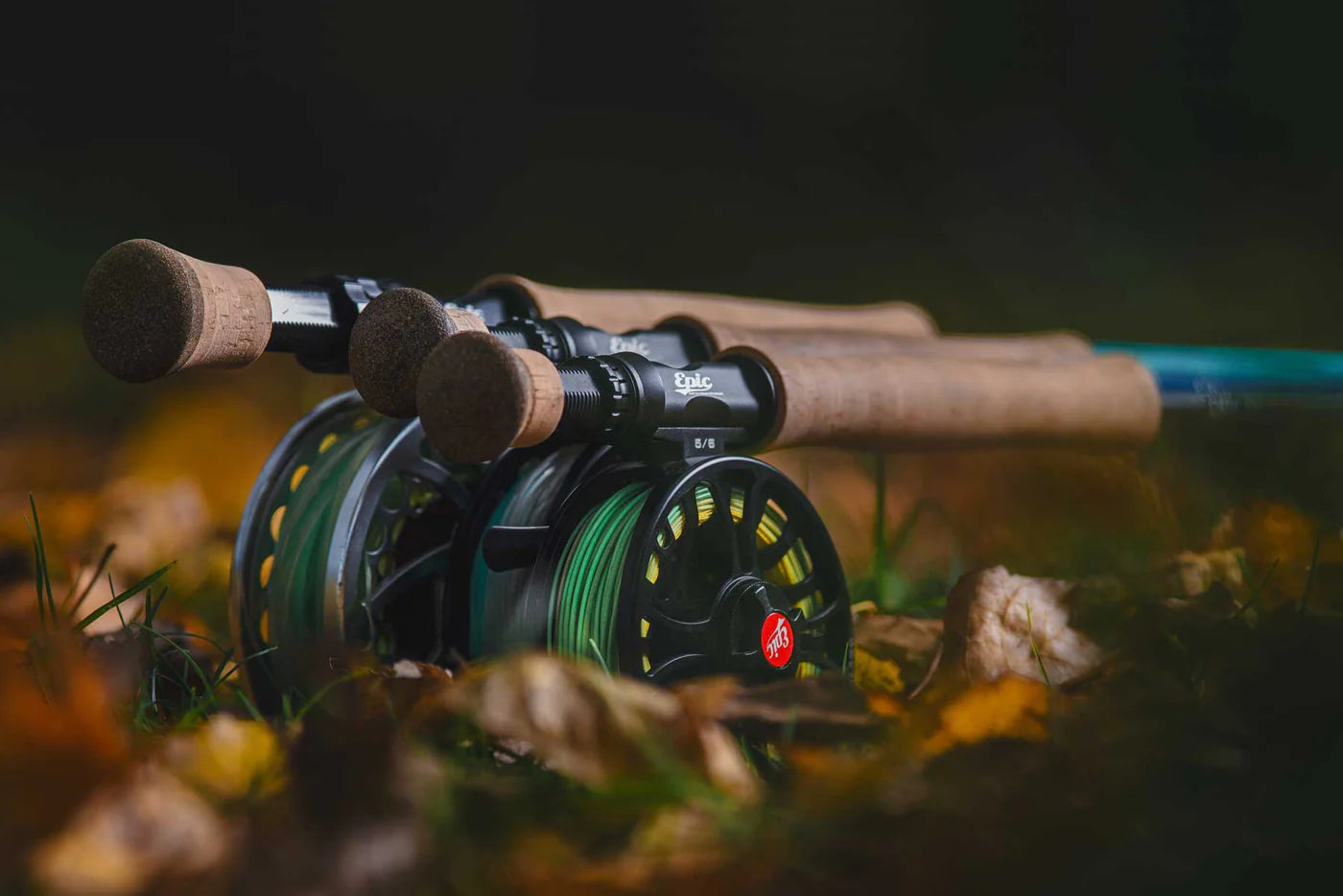
Custom Fly Rod – when a rod becomes your rod
Having a custom fly rod made means far more than simply adding a name to a production blank or choosing the color of the wraps. A true custom rod comes into being when the blank, length, line class, action, grip, reel seat, and guides combine to form a harmonious overall system.
Because on the water, these are precisely the details that make the difference.
How delicately can a dry fly be presented? How well does the rod load at the preferred casting distance? How much line can be mended controllably? How directly do you feel a nymph – and how confidently does the rod cast a streamer even against the wind?
A custom fly rod is therefore particularly worthwhile when your fishing style is clearly defined – or when a production rod almost fits, but only almost.
Anglers who regularly nymph with long leaders, cast streamers a long distance on the coast, or are looking for a light dry fly rod for small waters have very different requirements for their rod.
A custom-made fly rod starts precisely with these requirements, instead of trying to cover as many applications as possible with a compromise.
When is it worth having a custom fly rod made?
The greatest benefit of a custom rod is not automatically greater casting distance.
Far more important is that hard-to-describe feeling when a rod just fits.
It loads where you expect it to. It follows your casting rhythm. The tip provides feedback without feeling nervous. The line and blank work together, not against each other.
Experienced fly fishermen, in particular, quickly notice if a rod is too fast or too stiff for their casting style, if the tip gives them too little feedback, or if the grip diameter and contour simply don't fit their hand.
With a custom build, these factors can be precisely coordinated.
This starts with the selection of the fly rod blank: Should it be a moderate fiberglass blank with a deep flex curve? A modern carbon blank with progressive action? Or a fast high-modulus blank with high recovery speed?
Then follow the components that influence the balance, weight, durability, and ultimately the character of the finished rod.
And, of course, a custom rod can also be something special visually.
Fine silk wraps, subtle decorative wraps, a high-quality reel seat with a wooden spacer, modern carbon components, or an agate stripping guide can turn a fly rod into a very personal piece of craftsmanship.
The most important rule remains:
The design should emphasize the character of the rod – never impair its function.
The fly rod blank determines the rod's character
The blank is the heart of every fly rod.
Length and line class are important starting points, but they are not sufficient for selecting a suitable blank.
Two fly rods of 9 feet in length and #5 line class can feel completely different. One loads deeper into the blank and conveys a calm, progressive casting feel. The other has a more pronounced tip action, higher recovery speed, and feels more direct and faster.
Both can be excellent fly rods.
But not necessarily for the same fly fisherman.
And that is precisely why the decision in fly rod building should not be based solely on length and line class.
Small streams and light trout rods
For fishing for trout and grayling in smaller waters, light line classes between #2 and #4 are often an excellent choice.
Short blanks between about 6'6" and 8'6" excel where bushes, trees, and limited back cast room restrict casting space.
Modern fiberglass blanks, in particular, can be incredibly fun here. They load excellently with little line and convey an intense feeling even with smaller fish.
On larger waters, a longer rod, on the other hand, offers additional possibilities for line control, mending, and drift control.
The classic 9-foot #5 rod remains one of the most universal all-rounders in fly fishing for good reason.
Dry fly, nymph, and smaller streamers can be excellently covered in many situations.
Streamers, coast, and larger fish
With heavier streamers, pike, sea trout, or coastal fishing, the requirements change.
Here, line class, recovery power, stability, and the ability to transport larger flies and corresponding line profiles controllably play a much greater role.
A #7 or #8 does not necessarily have to be extremely fast and stiff.
A progressive action, in particular, can ensure that the rod builds up harmoniously under increasing load and remains pleasant to cast even during longer casting sessions.
In windy conditions and with large flies, higher line speed and fast recovery can, in turn, offer significant advantages.
For saltwater use, additional factors come into play: corrosion-resistant components, robust reel seats, and guides that are matched to strong leaders, larger line profiles, and high loads.
Euro Nymphing and ESN – when sensitivity and control are decisive
With Euro Nymphing or ESN, different requirements apply than with a classic all-round fly rod.
Here, length, low weight, a sensitive tip, and the most direct possible contact with the nymph are paramount.
A 10 or 11-foot rod in class #2 or #3 allows for excellent drift control and helps keep a larger part of the line or leader off the water.
At the same time, the tip must be fine enough to immediately convey contacts and bites, while the rest of the blank needs enough reserve to safely control a fish.
However, as a universal dry fly rod, such a rod would often be too specialized.
This is precisely where the advantage of individual planning becomes apparent: The rod is built for its actual purpose.
Carbon or fiberglass – which blank material is right for me?
Modern carbon blanks allow for high recovery speeds and precisely defined actions with very low weight. As a result, they now cover almost the entire spectrum of fly fishing.
From ultra-light nymph blanks to powerful saltwater rods.
Fiberglass, on the other hand, has a very distinct character.
Modern S-Glass and E-Glass blanks combine a deeper flex curve with a calm, very direct feel for the working rod.
Especially in small stream fly fishing, at short to medium casting distances, and with light line classes, a modern fiberglass fly rod can therefore be much more than a nostalgic gimmick.
Casting becomes more conscious. You feel the blank load – and even a small fish brings the entire rod to life.
Blank series and brands – Character instead of logo
Different manufacturers and blank series have their own signature.
A blank from Thomas & Thomas, EPIC, Winston or Soulmate can embody completely different properties and philosophies.
Therefore, the brand name alone should never be the deciding factor.
Much more important is the question:
Does the action of this blank suit my casting style, my line, and the way and where I actually fish?
Only when these points align does a high-quality blank become a truly good fly rod.
Guiding a fly rod – small components with a big impact
If you want to have a custom fly rod made, you should not consider the guides solely from an aesthetic point of view.
Ring type, ring size, weight, and ring position influence line guidance and weight distribution and can particularly affect the recovery behavior of the blank in the sensitive tip area.
A precisely matched guide setup supports the natural flex curve of the blank. Overly heavy components in the tip area, on the other hand, can make a very light blank feel unnecessarily sluggish.
For light stream and dry fly rods, therefore, the focus is on the lowest possible weight and a sensitive tip.
Subtle wraps, light snake guides, and a suitable tip-top keep the build slim.
For coastal, pike, or saltwater rods, other requirements are paramount. Here, larger stripping guides and robust, corrosion-resistant materials can be useful to ensure that fly line, shooting head, and strong leaders run reliably and with as little interference as possible through the guides.
Reel seat and balance
The reel seat is far more than a decorative component.
Material and design influence both the overall weight and the balance of the finished fly rod.
A lightweight uplocking reel seat is an excellent match for many modern single-hand rods. A downlocking concept can be particularly interesting for certain short or very light builds, if the reel and reel seat are deliberately to be positioned further towards the butt.
Wooden spacers convey warmth and a classic character. Aluminum and carbon can emphasize a modern, technical build and are particularly suitable where robustness and resistance are required.
For powerful fly rods of higher line classes, a fighting butt can also be useful and provide additional grip when fighting larger fish.
The right fly rod grip
Hardly any part of the rod has as much direct contact with the fly fisherman as the grip.
Therefore, there is no universal "right" here either.
Cork has been the classic in fly rod building for decades – light, warm, and comfortable in the hand.
Modern carbon grips, on the other hand, offer very direct feedback and a completely different, technical look.
Grip contour and diameter are decisive.
A delicate #3 usually does not require a massive full-wells grip. At the same time, the grip of a strong coastal or streamer rod should offer enough volume to lie securely and comfortably in the hand even during long casting sessions.
With a custom fly rod, exactly that can be taken into account.
The right configuration begins with your fishing
A custom fly rod becomes all the better the more precisely its later use can be described.
"I want a rod for trout" is a start.
Much more interesting is:
Where do you fish?
How far do you usually cast?
Which flies do you use?
Which line profiles do you prefer?
How long are your leaders?
Do you mainly fish dry flies, nymphs, or streamers?
And what feeling do you want to have when casting?
For planning a custom fly rod, the following information is particularly helpful:
- Target fish and type of water – for example, small stream, large river, stillwater, or coast
- typical fly sizes, weights, and leader lengths
- desired line class and preferred fly lines or line profiles
- casting style, experience level, and preferred rod feel
- preferred length and action of the fly rod
- requirements for grip, reel seat, guides, optics, and personalization
If you already own a favorite rod, you should also mention it as a reference.
Often, the statement "Exactly this feeling – but a little more feedback in the tip" is much more helpful to a rod builder than a mere list of technical data.
Have a fly rod made or build it yourself?
A custom fly rod from a rod builder is the right choice if the most precisely matched result is desired and the selection and craftsmanship are to be in experienced hands.
Building your own fly rod, on the other hand, has a completely different appeal.
Because eventually you stand in the water with a rod and know:
Every wrap, every guide, and every single step on it came from me.
The story of this rod doesn't begin with the first fish.
It begins at the wrapping stand.
With a rod building kit or individually assembled components, a fly rod can be built step by step. In doing so, you not only learn a lot about rod building but also develop a completely different relationship with your own equipment.
However, a clean build requires some patience. Grip fitting, guide alignment, clean wraps, and careful varnish application have a great influence on the final result.
At MB-Customrods you will find fly rod blanks, reel seats, cork grips, guides, wrapping threads, varnishes, adhesives, and rod building tools for the complete construction of your own fly rod.
Whether it's an individual custom rod or your own rod building project: The components should be coordinated before assembly – and not only when they are on the workbench.
Allocate the budget where it matters on the water
A custom fly rod does not have to consist of the most expensive available components.
Much more important is to use the budget wisely.
The fly rod blank deserves special attention, as it significantly defines the action, flex curve, and intended use of the finished rod.
After that, the guides, reel seat, and grip should be chosen to match the blank and the planned use.
For an ultra-light stream rod, an unnecessarily heavy hardware setup offers no advantage. For a saltwater rod, on the other hand, it would be wrong to skimp on corrosion-resistant and durable components.
And one component is often forgotten in planning:
the fly line.
A superbly built #5 can feel completely different with an unsuitable line than planned. Weight, taper, and head length influence when and how the blank loads.
A custom rod therefore never works in isolation.
Blank, build, reel, backing, fly line, leader, and fly form a system on the water.
Ultimately, it's about that one feeling
The best custom fly rod is not necessarily the most expensive, fastest, or most conspicuous.
It's the rod you repeatedly take out of its case on the water.
Because the grip fits perfectly in your hand.
Because you feel the blank load on the first false cast.
Because the fly lands where you want it to.
And because at some point, you no longer think about which components were used.
You just fish.
That's precisely why it's worth having a custom fly rod made – or building one yourself.