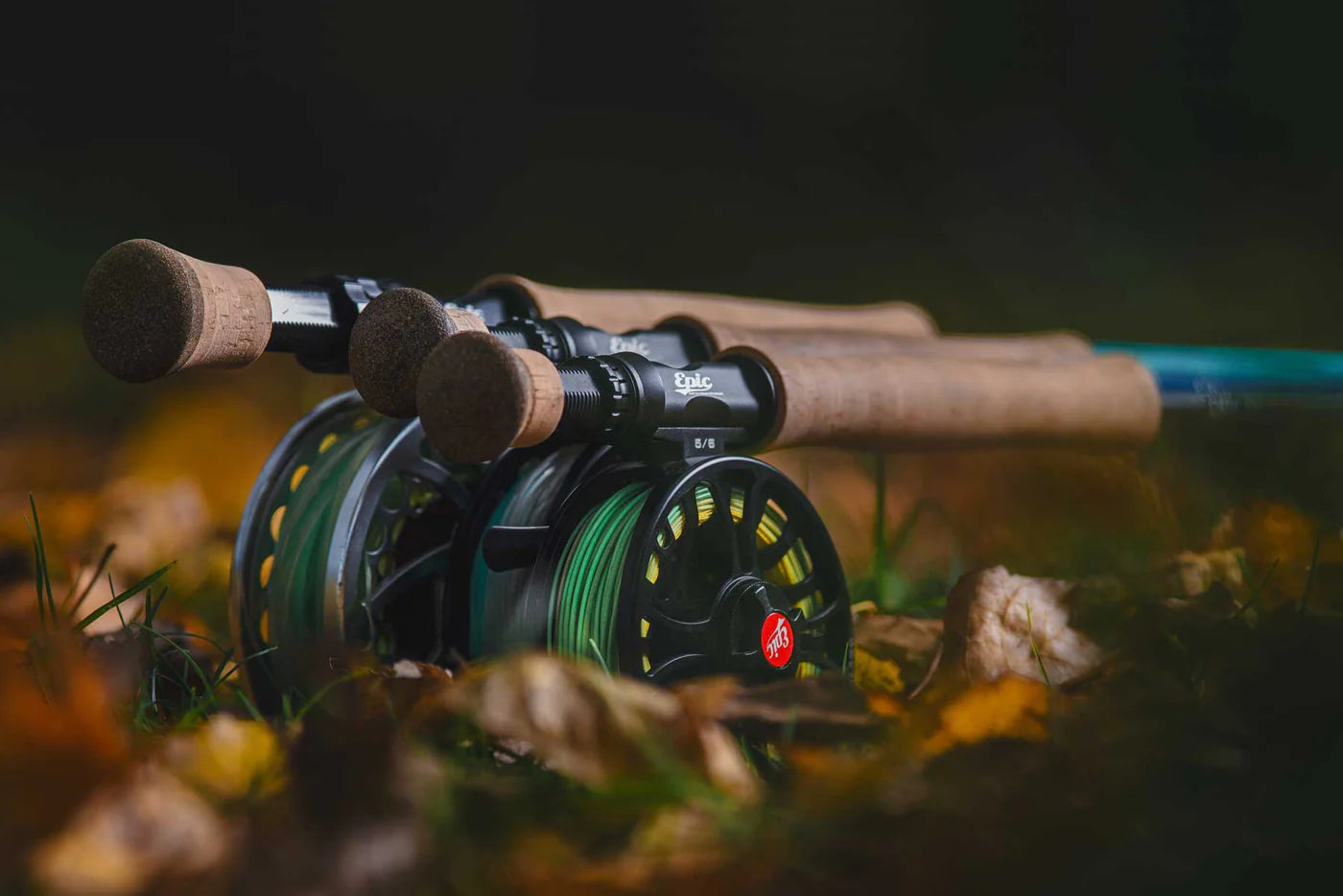
Choosing the Optimal Reel Seat for Fly Rods
The reel seat of a fly rod is one of those components that, at first glance, seems surprisingly inconspicuous.
Until you build a rod yourself.
Then it quickly becomes clear: The reel seat doesn't just connect the fly reel and the blank. It influences balance, weight, ergonomics, and the overall character of a custom fly rod.
A fine wood spacer can add warmth to a classic dry fly rod. An ultralight downlocking reel seat can wonderfully complement a short smallstream rod. And for a powerful saltwater rod, reliability and a corrosion-resistant aluminum reel seat suddenly matter more than romance.
Therefore, if you want to choose a reel seat for a fly rod, you shouldn't start with the color.
But with the rod.
Blank.
Line class.
Application area.
Fly reel.
Grip.
Balance.
Only when these points harmonize will individual rod building components become a cohesive whole.
The Reel Seat is Part of the Overall Fly Rod Construction
When building a fly rod, the grip and reel seat should never be considered in isolation.
Together, they form the interface between the hand, the blank, and the fly reel.
This is precisely where the feel of the finished rod is determined.
A light #3 rod can suddenly feel heavy and sluggish with unnecessarily massive hardware.
A 10'6" nymphing rod might end up significantly tip-heavier than planned with an extremely light reel seat.
And for an #8 saltwater rod, a delicate freshwater reel seat can simply be the wrong choice.
Therefore, the optimal fly rod reel seat is not automatically the lightest or most expensive.
It is the one that fits the overall concept of the rod.
At MB-Customrods, you'll find various reel seats for fly rod building – from ultralight solutions for delicate trout rods to more robust designs for powerful single-hand and saltwater setups.
Choosing Reel Seats for Fly Rods: The Purpose Determines the Choice
A #2 or #3 rod for a small stream places entirely different demands than an #8 rod for the coast or tropics.
Therefore, the selection always begins with the question:
Where and how will this fly rod be fished later?
Small Streams and Light Dry Fly Rods
For a delicate smallstream or dry fly rod, low weight plays a significant role.
Especially short blanks are sensitive to unnecessarily massive components.
A slender reel seat with a light insert or spacer supports the delicate character of the blank and keeps the rear assembly compact.
For very light rods in classes #0 to #3, an ultralight cap-and-ring or downlocking reel seat, for example, can be interesting.
The Avante Ultralight ULX2 Cap and Ring Reel Seat weighs only 6.5 g and, according to the product description, is specifically designed for light fly rods in classes #0 to #3.
Especially with a short fiberglass blank or a fine carbon rod, such a solution can beautifully support the minimalist character of a build.
Reel Seats for Nymphing and ESN Rods
For long Euro-nymphing and ESN fly rods, the topic of balance becomes particularly interesting.
A 10-, 10'6"- or 11-foot nymphing rod inevitably has significantly more blank length in front of the hand than a short trout rod.
This creates a stronger forward tipping moment.
A reel seat that is as light as possible therefore seems logical at first – but can even worsen the balance.
When nymphing, it's not just the total weight that matters.
What matters is where this weight is located.
A slightly longer reel seat or a consciously chosen fly reel can bring the center of gravity closer to the hand and make the rod significantly more comfortable to wield for hours on end.
However, the reel seat should still not be unnecessarily massive.
For a sensitive ESN rod, the rule is:
As light as possible – but as heavy as necessary for good balance.
Coast and Saltwater
For a saltwater fly rod, priorities shift.
Here, the following matter:
- secure clamping of the fly reel
- corrosion-resistant materials
- durable threads
- robust locking nuts
- stable hoods
- surfaces that are as easy to maintain as possible
A high-quality anodized aluminum reel seat is usually a more sensible solution here than a delicate natural wood spacer.
Moreover, large saltwater reels often have comparatively wide and long reel feet.
Therefore, it's not just about whether a reel seat is nominally recommended for a specific line class.
The actual fly reel must fit into the reel seat.
Before gluing, always perform a dry run with the reel that will actually be fished later.
Spey, Switch, and Powerful Single-Hand Rods
For Spey, Switch, and heavy single-hand rods, the rear rod assembly becomes more functional.
Longer reel seats, rear grips, and fighting butts are often used here.
A fighting butt is not just for decoration.
It provides additional grip when fighting larger fish and protects the end of the rod.
For two-hand rods, the rear grip is also an essential part of the casting technique.
Reel seat and rear grip must therefore be planned as a cohesive assembly here.
Uplocking or Downlocking Reel Seat?
One of the most common questions in fly rod building is:
Uplocking or Downlocking?
Both systems work excellently.
They differ mainly in the direction in which the movable locking nuts clamp the reel against the fixed hood.
Uplocking Reel Seat
With an uplocking reel seat, the movable screw nut is screwed towards the grip.
The fly reel is therefore clamped forward or "up" towards the grip.
This design is very common for modern single-hand fly rods.
It offers a compact, clean line between the grip and the reel seat and can be perfectly combined with a fighting butt.
Uplocking reel seats are therefore particularly common on:
- classic trout rods
- #4 to #6 all-round rods
- streamer rods
- coastal and saltwater rods
Downlocking Reel Seat
With a downlocking reel seat, the reel is positioned further towards the butt or rod end.
This can be interesting for short or very light fly rods.
The reel positioned further back changes the center of gravity and can look very harmonious, especially with classic fiberglass, bamboo, or smallstream builds.
Cap-and-ring systems often work on this principle as well.
The ultralight Avante ULX2 Cap and Ring Reel Seat, for example, is expressly designed as a light downlocking reel seat for rods in classes #0 to #3.
However, whether downlocking actually results in better balance always depends on the complete setup.
Blank length, grip, reel seat, and fly reel must be considered together.
The Correct Bore of the Reel Seat
One of the most important technical points in building a fly rod is the inner diameter of the reel seat or insert.
This should not be estimated.
The outer diameter of the blank is measured exactly at the position where the reel seat will be mounted later.
Not just at the outermost butt end.
A blank can also be slightly conical in the lower area.
A caliper is therefore essential equipment for rod building.
The reel seat does not have to fit tightly on the blank.
On the contrary.
It needs some space for clean gluing or for the arbors used.
Reel Seat with Insert or Spacer
Many classic fly rod reel seats consist of two functional areas:
the actual hardware
and the insert or spacer.
The spacer can be made of, for example, the following materials:
- stabilized wood
- carbon
- cork
- burl cork
- aluminum or other metal
Especially with classic custom rods, a beautiful wood spacer is one of the most striking details of the entire build.
It can harmonize perfectly with blank color, windings, and cork grip.
However, with a reel seat with a visible spacer, the bore must be particularly clean.
If a wood or carbon insert is subsequently drilled out or reamed, this should be done as precisely and centrally as possible.
A crooked reel seat is immediately noticeable on a high-quality custom fly rod.
Arbors – The Invisible Base of the Reel Seat
If the inner diameter of the reel seat is larger than the blank diameter, the difference is not simply filled with a thick layer of epoxy.
This is where arbors come into play.
An arbor centers the reel seat on the blank and creates a controlled gluing surface.
Suitable materials can include, for example:
- special polyurethane arbors
- matching cork arbors
- suitable tape arbors
- other materials specifically intended for rod building
What is crucial is:
The reel seat should be cleanly centered.
A large void filled with adhesive is not an elegant rod-building solution.
Epoxy adhesive connects the components.
The arbor ensures the correct fit.
Dry Fit Reel Seat – Before Epoxy Comes into Play
One of the best tips in fly rod building is:
First, assemble completely dry. Then glue.
Before mixing epoxy, all components of the grip area should be test-fitted.
Depending on the build, these include:
- fighting butt
- reel seat
- cork grip
- winding check
- possibly rear grip
- possibly trim rings
Now you can check:
Does the overall length fit?
Are all transitions clean?
Is there enough space for the locking nuts?
Is the reel seat aligned with the blank?
Does the fly reel actually fit?
Only when everything is correct, then glue.
These ten minutes of dry assembly can prevent a lot of rework later.
Aluminum Reel Seat – The Modern All-Rounder
Aluminum is one of the most widespread materials for fly rod reel seats today.
There are good reasons for this.
It is comparatively lightweight, can be worked with high precision, and can be anodized excellently.
This provides numerous surface finishes:
Black.
Gunsmoke.
Titanium.
Silver.
Bronze.
Or other modern finishes.
For freshwater rods, high-quality aluminum is an excellent choice.
Anodized aluminum can also be very suitable for saltwater, provided the design and finish are explicitly designed for this stress.
However, as with all saltwater components:
After fishing, clean with fresh water and completely remove salt from the reel seat thread.
Wood Spacer – When a Fly Rod Needs Character
There are few components that influence the visual character of a custom fly rod as strongly as a beautiful wood spacer.
Grain and color make each build a little more individual.
Especially with:
- classic dry fly rods
- fiberglass rods
- light trout rods
- traditionally built custom rods
wood can work excellently.
Proper sealing is important.
The wood should be protected against moisture and fit precisely into the reel seat hardware.
A good spacer does not look like a decorative element added later.
It appears as a natural part of the rod.
Carbon – Technical and Modern
Carbon inserts harmonize excellently with modern high-modulus blanks and minimalist rod designs.
They appear technical and clean.
Especially in combination with black or gunsmoke hardware, a very modern look is created.
For performance-oriented rods, a carbon spacer can therefore be an interesting alternative to classic wood.
Cap and Ring – Minimalist and Classic
Not every fly rod requires a screw thread.
For very light rods, classic cap-and-ring reel seats can work excellently.
A fixed butt cap and a sliding ring hold the reel foot.
The major advantage:
extremely little hardware and thus very low weight.
This is particularly well suited for:
- #0 to #3 rods
- short smallstream rods
- fiberglass fly rods
- classic builds
The Avante Ultralight ULX2 is a typical example of this concept and weighs only 6.5 g, including the cork insert.
Weight is Important – Balance is More Important
When buying a reel seat, often only the weight is compared.
But the number alone says little about how the finished fly rod will feel in the hand later.
Because the reel seat sits at the very back of the rod.
Even a few grams there can have a significantly greater impact on the center of gravity than the same mass further forward on the blank.
This can be positive.
Or negative.
For a short #3 rod, you usually want the lightest possible setup.
For a long nymphing rod, however, some weight behind the hand can help reduce the tipping moment of the long blank.
Therefore, a custom rod should ideally be tested with the fly reel that will be used later.
The Fly Reel Belongs in the Planning
A reel seat is not built for a theoretical line class.
It is built for a real fly reel.
Therefore:
Place the reel on the workbench during rod building.
Check the reel foot.
How wide is it?
How long?
How thick?
Do both hoods grip cleanly?
Can the locking nut be closed sufficiently far?
Especially with older, very small, or unusually designed fly reels, the reel foot may deviate from modern standards.
A dry run prevents the finished rod from not working with your favorite reel later on.
Fighting Butt – When Does a Fly Rod Need One?
For light trout rods, a fighting butt is usually not necessary.
However, from higher line classes, it becomes increasingly useful.
Typical applications include:
- streamer rods
- sea trout rods
- bonefish rods
- pike rods
- salmon and steelhead rods
- other powerful saltwater rods
A fighting butt provides additional grip during the fight and at the same time protects the rear end of the rod.
It should be considered from the beginning of the planning stage.
A fighting butt "somehow" attached afterwards rarely looks as clean as a consistently planned grip and reel seat concept.
What Reel Seat Size Fits My Fly Rod?
There is no universal table here.
A rough orientation is possible.
A light #2 or #3 rod usually requires significantly less hardware than an #8.
But:
The line class alone does not decide.
An ultralight 10'6" #3 ESN rod has different requirements than a 7' #3 fiberglass rod.
A #6 streamer rod may need a more robust reel seat than a light #6 dry fly rod.
Therefore, the following should always be considered together:
Blank + Length + Line Class + Grip + Reel + Application.
Common Mistakes with Reel Seats in Fly Rod Building
Some mistakes repeatedly occur in rod building.
Choosing a Reel Seat Based on Appearance Only
Gunsmoke might look perfect with the blank.
However, if the reel seat is too heavy or the bore is completely unsuitable, the finest finish will be of little help.
Do not test the reel foot beforehand
Especially with unusual fly reels, the finished rod can hold an unpleasant surprise later on.
Fill oversized bore with adhesive only
Large differences should be compensated with suitable arbors.
Plan grip and reel seat separately
Both components form a functional unit.
Check balance only without reel
The rod will not be fished later without a reel.
Therefore, the intended fly reel should be on the table already during planning.
Ignore saltwater suitability
A beautiful wooden spacer and delicate hardware can be perfect for a dry fly rod.
For frequent saltwater fishing, a more robust, fully metallic construction might be the better choice.
Which reel seat fits which fly rod?
As a rough guide:
Light #0-#3 Smallstream and Fiberglass rods:
light cap-and-ring or slim downlocking systems.
#3-#5 Trout and Dry Fly rods:
light uplocking or classic reel seats with wood, carbon or cork spacers.
ESN and Nymphing rods:
light hardware, but always check balance with reel.
#5-#7 All-round and Streamer rods:
stable uplocking reel seat, possibly with fighting butt depending on the intended use.
#7-#12 Coastal and Saltwater rods:
robust anodized aluminum hardware, secure double-locking solution and fighting butt.
This assignment is not a rigid rule.
It is a starting point.
Because that's exactly what makes a custom rod so appealing:
You don't build just any fly rod. You build exactly yours.
Buying a reel seat – thinking as a system is better
If you want to buy a reel seat for fly rod building, you should therefore not only consider a single component.
Ideally, the following are selected together:
- Blank
- Reel seat
- Cork grip
- Winding check
- possibly fighting butt
- Fly reel
At MB-Customrods you will find the corresponding reel seats and rod building components for fly rods as well as blanks, grips, guides, winding threads, adhesives and tools for complete fly rod building.
Especially for the first self-build, it is worth coordinating the components before purchasing.
Because good rod building begins long before the first guide is wound.
The reel seat is small – but you feel it with every cast
Perhaps the reel seat is not the component of a fly rod that is most often talked about on the water.
But you hold it in your hand with every single cast.
It determines where the fly reel sits.
How the rod balances.
How grip and reel merge.
And how the entire custom rod feels.
When blank, grip, reel seat and fly reel really fit together, you stop thinking about it at some point.
The rod just feels right.
And that's exactly the goal in the end when building a fly rod.
Not to assemble as many expensive individual parts as possible.
But to build a fly rod from them, where every component sits exactly where it belongs.
Until you're standing by the water, picking up the line, and only thinking about the next cast.