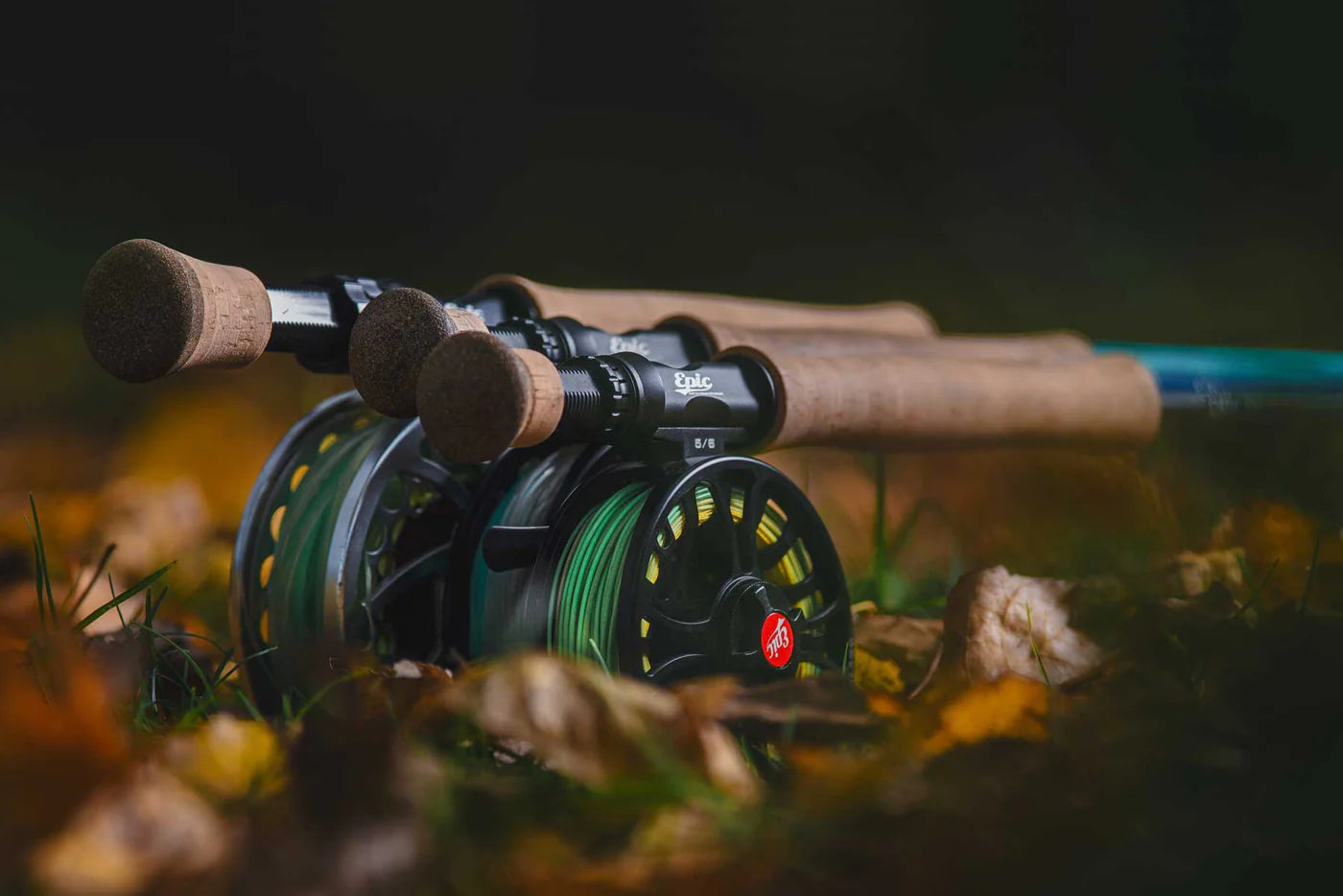
How to properly care for the cork handle of a fly rod
A good cork handle of a fly rod should show that it has been fished.
Over time, the light natural cork will darken a bit. The hand leaves its marks. A little dirt from the stream, sunscreen on a long summer day, or salt after a week on the coast eventually become part of a rod's history.
Especially with a self-built custom fly rod, this patina is not a flaw for many fly fishers.
It reminds them of days on the water. Of fish. Of travels. And of thousands of casts.
Nevertheless, natural cork needs some care. Not so that the handle still looks as if it had never seen water after years – but so that it remains dry, grippy, and comfortable in the hand.
But how do you properly care for cork handles without damaging the natural surface?
The most important rule is:
As much care as necessary. As little intervention as possible.
Why does the cork handle of a fly rod need care at all?
Cork has been one of the classic materials in fly rod building for decades.
And for good reason.
Natural cork is light, pleasantly warm, offers good grip even with wet hands, and provides a very direct contact with the working rod.
Especially for a delicate dry fly rod or a light fiberglass fly rod, a high-quality cork handle is simply essential for many fly fishers.
However, cork is a natural material.
Its surface has pores and natural irregularities where sweat, skin oil, sunscreen, dirt, or other residues can accumulate over time.
After many days on the water, this creates the typical darker patina of a well-fished cork handle.
This is completely normal at first.
A darkened cork handle changes neither the action of the blank nor the performance of the fly rod. Care becomes particularly important when salt, heavy soiling, or persistent moisture remains in or on the handle.
Flor-Cork – why quality matters in rod building
Anyone building a high-quality fly rod will quickly come across terms like Flor-Cork or Flor Plus Cork when selecting the handle.
Flor refers to a particularly high-quality selection of natural cork. Good Flor-Cork has a comparatively even and dense structure with as few large pores and imperfections as possible. This reduces the need for fillers, and the finished fly rod handle appears particularly homogeneous.
Especially for high-quality Custom Rods, Flor-Cork is therefore a popular choice.
It feels pleasant, remains light, and develops a beautiful natural patina with increasing use.
At MB-Customrods, you will find various high-quality Flor-Plus cork handles for building your own fly rod – for example, the Slim Ritz FLOR Plus, the Western Slim FLOR Plus, the Full Wells Slim FLOR Plus or the Slim Jim / Snub Nose FLOR Plus.
A high-quality handle is not just an aesthetic decision.
After all, the cork handle is the component of your fly rod that you constantly hold in your hand throughout an entire day on the water.
The handle contour is part of a fly rod's character
Not every fly rod needs the same cork handle.
In fly rod building, various handle contours have become established that not only define the look of a custom rod but also influence how the finished rod feels in the hand.
Slim Ritz – for delicate and light fly rods
Especially for a delicate dry fly rod, a light nymphing rod, or a classic small stream setup, a slender handle perfectly complements the character of the blank.
The Slim Ritz Fly Rod Cork Handle – FLOR Plus, for example, is designed for delicate fly rods in classes #2 to #4.
Its slender contour is particularly well suited for light setups where one wants to add as little unnecessary mass as possible.
Western Slim – classic and elegant
The Western grip is one of the classic handle contours in fly rod building.
For those who want to combine this traditional shape with a slightly slimmer, modern design, the Western Slim Fly Rod Cork Handle – FLOR Plus provides a beautiful base for a light and elegant custom build.
Especially for a fly rod that is fished for many hours on the water, the shape, diameter, and quality of the cork are at least as important as the pure aesthetics.
Full Wells Slim – more support without appearing bulky
The Full-Wells grip offers a more pronounced front handle contour and is often used with somewhat stronger fly rods.
If you prefer this ergonomics but still want to keep the build sleek and elegant, you can opt for the Full Wells Slim Fly Rod Cork Handle – FLOR Plus, for example.
This allows the handle contour to be deliberately matched to the line class, blank, hand size, and personal casting style.
Slim Jim / Snub Nose – compact and modern
Compact grip contours also have their appeal in modern fly rod building.
The Slim Jim / Snub Nose Fly Rod Cork Handle – FLOR Plus is suitable for fly rods in classes #2 to #5 and offers an interesting alternative for modern, minimalist custom builds.
Especially for light to medium trout rods, such a compact grip contour can emphasize the character of the entire rod.
Regardless of the chosen shape, however, the following applies:
Natural cork should generally be cared for as gently as possible.
Properly caring for cork handles after fly fishing
After a normal day at the trout stream, a cork handle usually doesn't require intensive cleaning.
If the handle is merely a little damp or superficially soiled, a clean, slightly moistened cloth will suffice.
This removes mud, dust, and light residues before they dry completely.
Afterward, simply let the handle air dry at room temperature.
Not on the heater.
Not in direct sunlight.
And most importantly:
Do not store a still damp fly rod directly in its closed rod sock and rod tube for an extended period.
The cork handle should be able to dry completely.
Cleaning the cork handle after saltwater fishing
After fishing in saltwater, the situation is a bit different.
Salt residues should not remain permanently in the cork.
In this case, the handle should be cleaned more thoroughly with clean fresh water or a well-dampened cloth. The cork does not need to be soaked.
The sole aim is to remove salt from the surface and from the superficial pores.
Special attention should be paid to the transitions:
Cork handle → Winding Check → Blank
and
Cork handle → Reel Seat
Water, salt, and dirt can accumulate there.
Then, allow the rod to air dry completely.
The simple care routine for a cork handle
For normal care, a few steps are sufficient:
1. Remove coarse dirt with a slightly damp, soft cloth.
2. In case of saltwater contact, carefully remove salt from the handle with fresh water or a damp cloth.
3. Absorb excess moisture with a clean cloth.
4. Allow the fly rod to dry completely in the open at room temperature.
5. Only then store it back in the rod sock and rod tube.
Anyone who follows this simple routine will rarely need to clean a high-quality cork handle more intensively.
And that's a good thing.
Because every intensive cleaning stresses the natural surface more than a simple wipe.
How to clean a heavily soiled cork handle?
Eventually, the moment comes anyway.
The originally light handle has significantly darkened. Sunscreen, hand sweat, and dirt have left their marks.
Perhaps you want to refurbish an older fly rod or refresh a particularly beautiful custom build.
Then the cork can be cleaned more intensively.
Use lukewarm water and a very small amount of mild soap for this.
A soft cloth or a soft sponge is sufficient. The handle should not be soaked.
Work in sections and with as little pressure as possible.
Then, remove soap residues with a second cloth, moistened only with clear water.
After that:
Let it dry completely.
What should not be applied to a cork handle?
Especially with high-quality Flor and Flor-Plus cork handles, one should be careful with aggressive cleaning agents.
Not recommended are, for example:
- Acetone or other solvents
- Brake cleaner
- Aggressive degreasers
- Scouring milk
- Hard brushes
- Aggressive household cleaners
- Furniture polishes
- Oils and greasy care products
Furthermore, oils or waxes can alter the natural grip.
A cork handle doesn't have to shine.
It has to feel good.
Beware of magic erasers
A so-called magic or melamine sponge can remove dark spots on cork astonishingly quickly.
The result initially looks excellent.
However, melamine foam works slightly abrasively. It does not solely clean, but mechanically removes material from the surface.
Therefore, on a high-quality Flor cork handle of a custom fly rod, I would only use it very sparingly and selectively.
An even patina is usually more beautiful than a handle with individual artificially brightened areas.
Can you sand a cork handle?
Yes.
But only when it is truly necessary.
An older, rough, or heavily soiled cork handle can be carefully restored with very fine sandpaper.
It should be noted that:
Sanding is not cleaning. Sanding is material removal.
Therefore, sandpaper is not part of the normal care for a cork handle.
If at all, very fine sandpaper should be used and worked with minimal pressure. The goal is not to artificially restore the handle to "new condition."
It is merely about carefully leveling loose fibers or heavily roughened areas.
Especially with an individually shaped handle, restraint is important.
Because the diameter and contour of the fly rod handle were deliberately chosen during construction.
What has been sanded off cannot be added back.
Small pores and fillers are normal in natural cork
Even high-quality Flor-Cork is a natural product.
Small pores and irregularities are therefore part of the material.
A completely pore-free handle is not automatically a sign of particularly high-quality natural cork.
What is more crucial is the density and quality of the material used, as well as the number and size of visible imperfections.
In high-quality handles, these are generally much less pronounced.
With increasing use, individual filler spots can come loose.
As long as they are small and do not interfere with fishing, there is no immediate need for action.
If a break-out becomes larger or is noticeable when gripping, the spot can be repaired.
Repairing a cork handle – when a filler comes out
A classic method in rod building is to mix fine cork dust with a suitable binder and fill the imperfection with it.
This requires the correct shade and the cleanest possible application.
Repair spots that are too dark, too light, or shiny often stand out more than the original pore.
After complete curing, the repaired area can be very carefully sanded flush.
However, for a high-quality custom rod or a particularly valuable fly rod, I would leave larger repairs to an experienced rod builder.
Especially if the damaged area is directly on the reel seat or winding check.
Should you seal a cork handle?
Opinions on this vary among fly fishermen and rod builders.
A special cork sealant can reduce dirt absorption. However, it may also change the feel of the natural cork.
And precisely this tactile quality is one of the reasons why we use cork on a fly rod in the first place.
Natural Flor-Cork feels warm and direct.
It changes.
It develops a patina.
It ages with the rod.
For a classic dry fly rod, a light fiberglass rod, or a high-quality custom build, natural Flor-Cork is therefore the more harmonious choice for many fly fishermen.
For an intensively used guiding rod or utility rod, a sealant specifically developed for fishing rod cork, on the other hand, might be worth considering.
Important:
Do not use furniture sealant, wood oil, or improvised coatings.
Also check reel seat, winding check, and fighting butt
When you clean the cork handle, it's also worth taking a look at the adjacent rod building components.
Check:
- the transition between cork handle and winding check
- the transition to the reel seat
- the reel seat threads
- any existing fighting butt
- visible glue joints
Especially after frequent saltwater use, this quick check is worthwhile.
Because a clean cork handle is of little help if salt and moisture remain in the reel seat threads right next to it.
Proper storage also protects the cork
Care does not end with cleaning.
The rod sock should also be checked occasionally.
Sand, dried mud, or salt residue can accumulate in it and get onto the blank and handle with every transport.
Therefore:
Shake out the rod sock and let it dry completely.
The rod tube should also be dry inside.
Furthermore, a fly rod should not be permanently stored in a hot car trunk or a damp basement.
Cork, adhesive bonds, blank finish, and reel seat all benefit equally from dry storage at as consistent a temperature as possible.
In fly rod building, a good cork handle begins with the right choice
Anyone who builds their own fly rod can lay the groundwork for years of enjoyment right from the handle selection.
The cork quality is only one factor.
Equally important are:
- Handle contour
- Handle diameter
- Handle length
- Weight
- Quality and density of the natural cork
- Clean transition to the reel seat
- Precise adaptation of the handle to the blank
And that is precisely one of the great advantages of custom rod building:
You decide how your fly rod should feel in your hand later.
At MB-Customrods, you will find various high-quality Flor-Plus cork handles for this purpose:
Slim Ritz FLOR Plus – particularly interesting for delicate fly rods in classes #2 to #4.
Western Slim FLOR Plus – a slender interpretation of the classic Western shape.
Full Wells Slim FLOR Plus – if a bit more support is desired, but the handle should still remain elegant and slender.
Slim Jim / Snub Nose FLOR Plus – a compact, modern grip contour for light to medium fly rods.
This allows the grip to be selected to match the blank, line class, hand size, and intended use of the fly rod.
A good cork grip doesn't have to look new
Perhaps that is even the most important point.
A cork grip that still looks exactly like it did on the first day after five years of intensive fishing has perhaps simply not seen enough water.
A slight patina is part of a much-fished fly rod.
It tells of a cold morning with a nymph.
Of a hot summer day with a dry fly.
Of rain.
Of travels.
Perhaps also of that one fish you'll remember years later.
That's why a well-maintained cork grip doesn't have to be immaculately white.
It should remain dry, firm, grippy, and comfortable in the hand.
Care for it.
But don't try to clean every trace of water out of it.
Because eventually, precisely this patina will belong to your fly rod just as much as the wraps, the reel seat, and the blank.
A good fly rod is allowed to show that it's been fished.